| StefanAvalos.com |
||
|
|
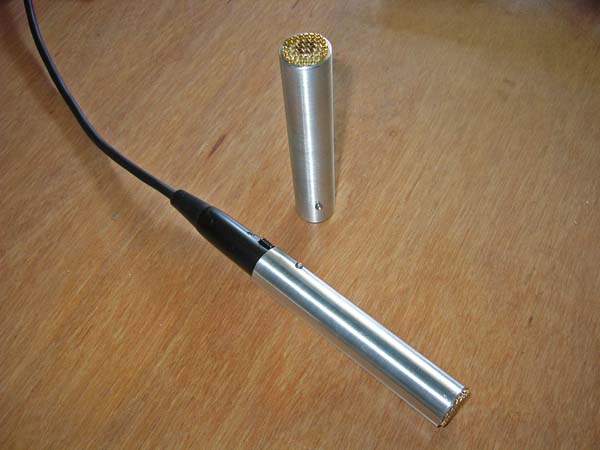
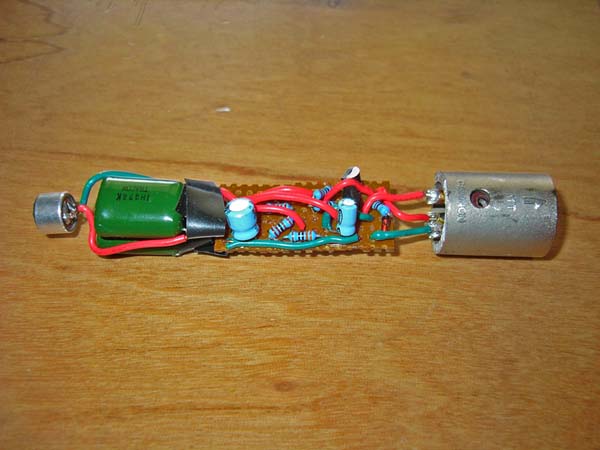
Omni microphones.Following the success of the Alice-Alike, I started playing with different capsules and different shapes. My intention is to build a collection of mics which can serve most purposes. I am waiting for some large-diaphragm capsules, so in the meantime, I started on small-diaphragm omnis. I tried several capsules from Transsound but found that the small omnis just weren't doing anything for me. Too noisy, muffled - basically good for what they were designed, cellphones, etc, but not much else. I Linkwitz modded them, ripped them apart, tried externalizing fets, etc. I haven't yet tried Panasonic capsules... they're next. They are very popular capsules and sound pretty good. After the Transsounds omni tests, I tried Projects Unlimited capsules. After poring through the specs on the various Projects Unlimited capsules, I requested samples of several capsules. They were alright, but not up to what I needed... except for one - the BOM-6538L (now the BOM-6538L-R). I hooked this capsule to the standard circuit - the Schoeps circuit used in the Alice. Since it has an internalized FET, it doesn't require the FET or the 1G resistor at the capsule. They sounded great. Amazingly so. I played with a pair of mutants (guts hanging from the XLR Jack) for a couple weeks, recording various things, trying to figure out whether I was hallucinating or not. I emailed a couple tests to a friend of mine who also agreed that they sounded pretty damn good. While doing this I was also trying to figure out what type of body I wanted to put them in. The omni's are much more susceptible to audio coloration based on the body then the cardioids. This makes sense as they're getting sound from all around, not primarily the area in front of them. You can hear changes in the sound by merely putting your hand in different places around or behind the capsule. It means that the body size and shape is of serious importance. I will make several more versions of this microphone and test them in different bodies. The shape of measurement mics makes a lot of sense. Earthworks microphones look like these. They basically look like a probe. It allows the capsule to sit way in front of the rest of the body. The best shape for an omni directional mic would seem to be a body-less mic, essentially something that looks like a Lavalier mic. The mounting issues would have to be addressed, though copying a Schoeps omni would be one good solution. In the mean time though - my immediate goal with these microphones was to bring the size of the body down as much as possible. For these, I chose 7/8 inch aluminum tubing. An XLR jack will fit snugly inside this. This allowed me to forego the expensive (for what it is) Switchcraft part, and use old XLR jacks for $1.00 a pop. I have found the cannon jacks to be the best for this project since they don't taper. I cut the XLR jacks down with a hacksaw and then went to work on laying the circuit out on the perfboard in such a way that I could get it into the narrower (then the Alice-Alikes) tube. I didn't want to compromise anything which meant figuring out how to get those mongo sized film capacitors into the small tube. I did this by bringing them to the front. This worked well because that area was occupied by the FET and 1G resistor in the cardioid Alice-Alikes. That area also needed to be open to soundwaves on the cardioids. With Omni's that's not the case.
The bodies were finished the same way as the Cardioids, and I filled around the capsule with the same soundproofing. I didn't put any wind protection foam in front of the cap -- so they sit right against the grille. Omnis are not as susceptible to wind noise as cardioids. The final result? These microphones look really elegant and they sound very smooth. They don't have the same top end as the cardioids, but actually sound less "brittle". The high end bump - hyped high end being a characteristic of Chinese Capsules is not really heard with these, though it exists on the graph. They have a lot of low end - in fact, they pick up stuff you barely hear. The rumble of an attic exhaust fan became much more evident, as did the refrigerator in the kitchen - on the opposite side of the house. They are amazingly sensitive (-38 db+-2db vs the Alice-Alike's -45db+-4db), which means that you don't need as much preamp gain. Their noise floor is 60db. The Alice-Alike capsule, the TSB165a, has a noise floor of 66DB. However, because of the decreased amp gain on the Omnis, they end up being quieter. For solo violin (and probably a lot of other strings) and binaural type ambient recordings,
I have found these are better microphones than the cardiods. It's great having a pair of these mics, and the cost of parts is ridiculously low. It looks as though the BOM-6538 capsule can be Linkwitz modded. I will try on the next batch I buy. I don't know how loud a sound they can take before distorting, though I guess it's a similar limitation to most low cost capsules. The Linkwitz mod will of course help this quite a bit. I could also put a switchable pad into the circuit easily enough.
Here is a Mouser BOM - copy and paste this list in the same way described on the cardoids page to order all the internal parts for two microphones. 610-2N5087 4 Cost as of Oct, 2006 for these parts is $5.98!! (shipping and tax not included) note: occasionally, Mouser catalog numbers change. If you get any changes, the mouser order will generally help you find the right part and update the b.o.m. However, make sure the quantity of parts is also accurately updated. Always Double check the order before placing it. The XLR jacks: if you live near a surplus store, buy them there, otherwise gut two old XLR cables for the male ends. I got them at APEX Electronics in Sunland (above Los Angeles) in a bin for $1.00 a piece. Perfboard can be bought at Radio shack - you only need 2 tiny pieces The body is 7/8 OD Aluminum tubing - it's about $1.20 per foot. The microphones are about 120 mm long, so 1 foot is more than enough for two microphones. So - for around $10.00-$15.00 in parts, you can have a pair of omni directional microphones that will rival microphones costing ten to twenty times that cost per microphone. I KID YOU NOT! As with the cardioids, I didn't put a roll off filter (which omni's don't really need) or a pad of any sort. It would be easy enough to do, and maybe I will on the next set. The capsules aren't interchangeable, etc. - so of course there are certain things you don't get. However, the quality of sound and the size of the microphones is sick. Trust me, if I read this, and saw the cost, I would be very dubious too.
email me if you like.
|
|